
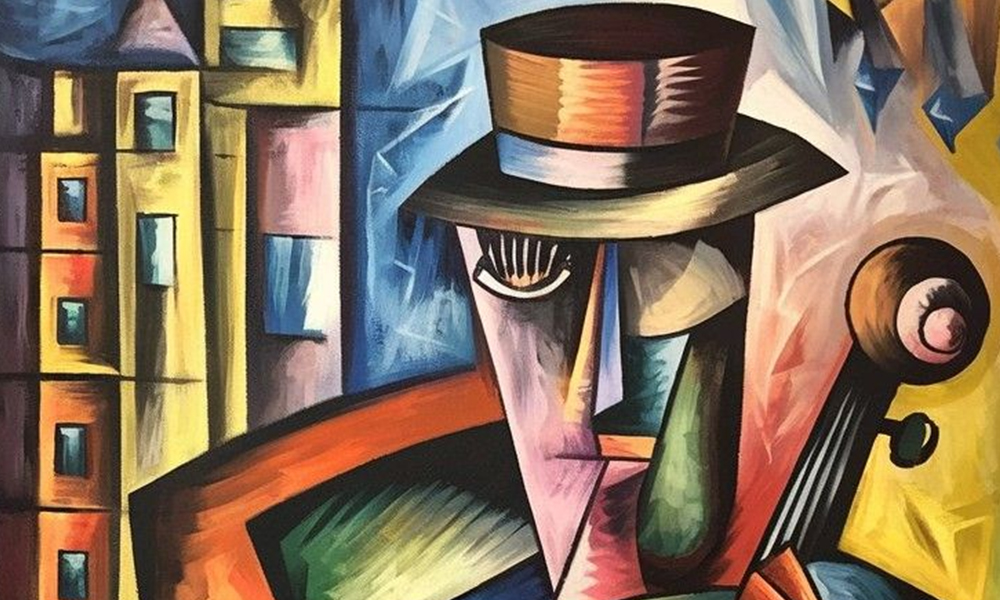

Cubism has been defined as one of the most revolutionary movements in modern art. It departed from the traditional representation of art that had been practiced for centuries and questioned how reality could be represented on canvas. A new book has now shed new light on why Cubism emerged as it did, going beyond the conventional explanations and providing new avenues of understanding the movement.
Instead of dwelling on the names and works of the masters of Cubism, the book presents the movement in a wider cultural and intellectual framework. It continues by saying that Cubism was not a fleeting artistic incident but a reaction to a world that was rapidly changing.
Scientific discoveries, technological developments, and a transformation in the social order were inducing a transformation in the way people thought about space, time, and perception. Artists were no longer content with representing the world as it appeared on the surface.
Through its explanation of the historical context of artistic innovation, the book demonstrates how Cubism naturally arose out of its context. It presents the movement not as a rebellious act but as a result of curiosity and inquiry.
Modern life reshapes artistic vision
One of the best concepts presented in the book is that the modern world changed the way artists perceived the world. Cities were expanding, machines were entering everyday life, and speed was the characteristic of the modern age. Single-point perspective, which was the traditional way of perspective, did not seem adequate anymore.
According to the book, the Cubist artists wanted to show many perspectives at once, which was the way the world was experienced. Things were no longer still; they were in motion, turning from different sides, and over time. Cubism was an attempt to capture this on a flat surface.
Another important concept is the role of non-Western art and ancient forms of representation. As per the book, artists started looking beyond European art for inspiration for new forms of representation.
The author also talks about the aspect of collaboration and dialogue among artists. Cubism did not appear in a vacuum. It appeared as a result of shared ideas, discussions, and endless experimentation. This was the secret to the emergence of the principles of Cubism.
Notably, the book disproves the idea that Cubism was a complex and confusing art movement. Instead, the book reveals Cubism to be a true attempt to make sense of a fragmented modern world. The broken shapes and overlapping surfaces were a visual answer to intellectual questions.
Through this, the book enhances our understanding of the origins of Cubism and the fact that art is inextricably linked to the world in which it exists.