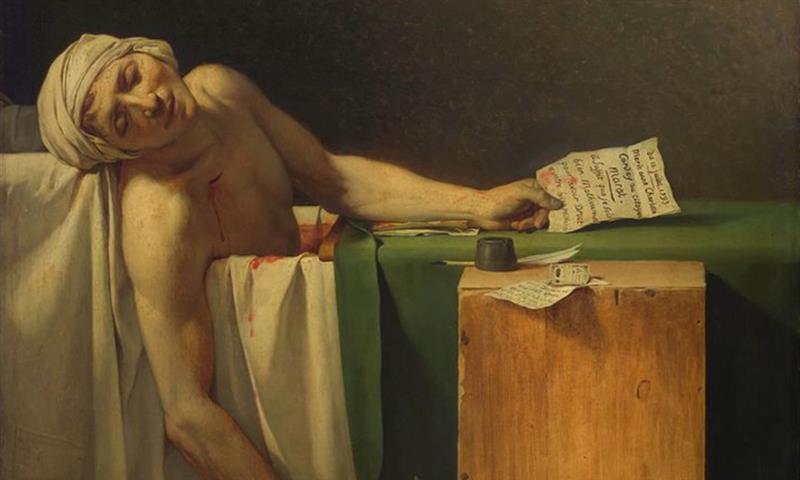

There is a new book out, which examines one of the greatest images of revolutionary art through a deeply personal approach. _The Death of Marat_ by the French artist Jacques-Louis David is a painting which has been studied as a political painting, as well as a Neoclassic masterpiece. From the approach of a lifelong enthusiast, the work is examined.
Unlike the conventional approach taken in most academic works, the book appears to be the outcome of several years spent studying the work with careful reflection. This approach assesses the work on the basis that the meaning evolves with time. There is concern with the effect that the encountering of the work has had on the interpretation process. This enables the analysis to encompass elements of the historian’s perspective as well as the personal perspective.
The historic setting of ‘The Death of Marat’ is dealt with appropriately. Painted in 1793, the piece is an elegy on the murder of the revolutionary Jean-Paul Marat and portrays the latter as a martyr of the French Revolution. David’s piece is characteristic of revolutionary propaganda. In the book, this political function is acknowledged while being placed alongside the artist’s careful manipulation of form, light, and symbolism.
Details within the painting are given particular emphasis. The simplicity of the setting, the quiet dignity of Marat’s body, and the carefully rendered letter in his hand are closely examined. These elements are interpreted not only as political devices but as emotional tools designed to guide the viewer’s response. Through this analysis, the painting is shown to operate simultaneously as image, message, and memorial.
Art History, Personal Perspective, and Lasting Influence
The long relationship the author has with the painting allows familiar interpretations to be re-considered. Instead of a fixed historical artifact, The Death of Marat is presented as something which continues to speak across generations. Changes in political climate, museum display and public perception are all considered.
The book also engages the role of admiration in the history of art. If scholarly distance has long been idealized, the author contends, sustained admiration can yield insight, rather than distortion. By avowing emotional investment, a more ‘poetic’ reading of the painting is advanced. This resistance offers a revision to the notion that objectivity requires detachment.
David’s position within art history is also reassessed. Technical skill and political commitment are examined in conjunction with his capacity to humanize ideology in visual form.” The influence of the painting in the later visual tradition of political martyrdom is touched upon in the course of this discussion that secures the image of The Death of Marat as a starting point in the history of revolution on the visual screen.
The book’s informal style makes the book accessible to general readers and scholars alike, a real asset. The concepts presented by the book are easily defined, helping to eliminate confusion, and personal thoughts are interspersed so that the text is an interpretation, also an invitation to look deeper into a piece that the general reader might believe he/she is familiar with.
In conclusion, the new book represents one different way of thinking about one of the most studied artworks in the annals of art history. With the perspective of one who has long revered the piece, the artwork is permitted to re-gain the nuances of the original. It is not simply re-visualized, but re-experienced. With the information presented, the reader is able to achieve an understanding of the effectiveness of long-lasting artworks in creating new meaning decades after the original was brought into being.