
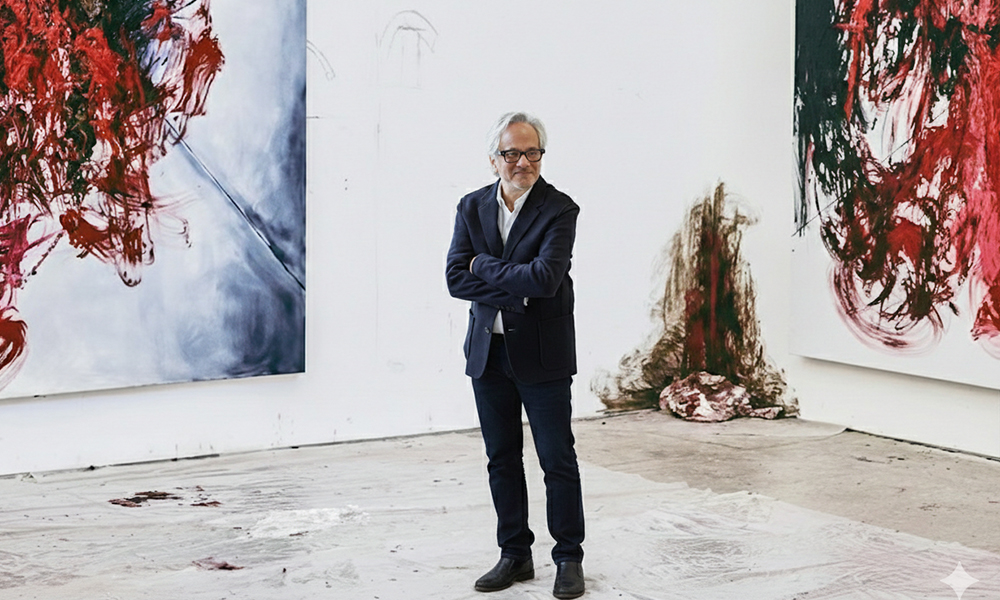

Renowned for pushing the limits of scale, material, and perception, Anish Kapoor’s talent as an artist who expands the limits of scale, materials, and perception with his large-scale works. He is developing new pieces for a world premiere exhibition in Venice that will include both completed works and conceptual art that has never been realized before.
Kapoor Explores Monumental Possibility
This exhibition provides an overview of Kapoor’s long fascination with large scale objects. Many of Kapoor’s installations raise questions about how big, how deep, and how immersive installations can be. Visitors entering Venice will experience momentous ideas that extend beyond the limits of practicality, revealing that the act of ambition itself can be an artistic force.
Visitors will also see that even though many of Kapoor’s unrealized works do not exist materially yet, they still hold considerable value. All of these concepts are equally valid, despite having no form whatsoever, and demonstrate the artist’s creative process and the risks and uncertainty involved in creating and imagining.
Kapoor also states that the artistic process does not require having a material presence in order to have meaning. Kapor believes that an artist can equally give an example of their creative process by creating drawings, models, or concepts as they can by creating a completed sculpture.
The role of the exhibition in Venice is critical to Kapoor’s exploration. The layered history and fragile architecture of Venice serve as a stark contrast to Kapoor’s dynamic and often very large visions. This tension creates a greater impact on both Kapoor’s finished works and unrealized works.
Visitors have been encouraged to think about how the unrealized projects can make a difference to their surroundings to offer new possibilities for architecture and create new uses of public space. This exhibit gives visitors the chance to collectively use their imagination to help fill in the blanks regarding these unrealized projects.
Themes of void, reflection, and transformation run throughout the show. Kapoor’s ideas repeatedly return to the unknown—spaces that absorb, conceal, or redefine human presence.
By presenting ambition without compromise, Kapoor challenges traditional definitions of success in art. What matters here is not whether a project was built, but whether it expands the way we think.
In Venice, these projects feel both grounded and dreamlike. They sit between reality and possibility, echoing the city’s own balance between past and present.
Ultimately, the exhibition positions ambition as an artwork in itself. Kapoor shows that unrealised ideas are not failures, but powerful statements of creative freedom.
This Venice presentation stands as a bold reminder that art’s greatest impact often begins long before it takes physical shape.