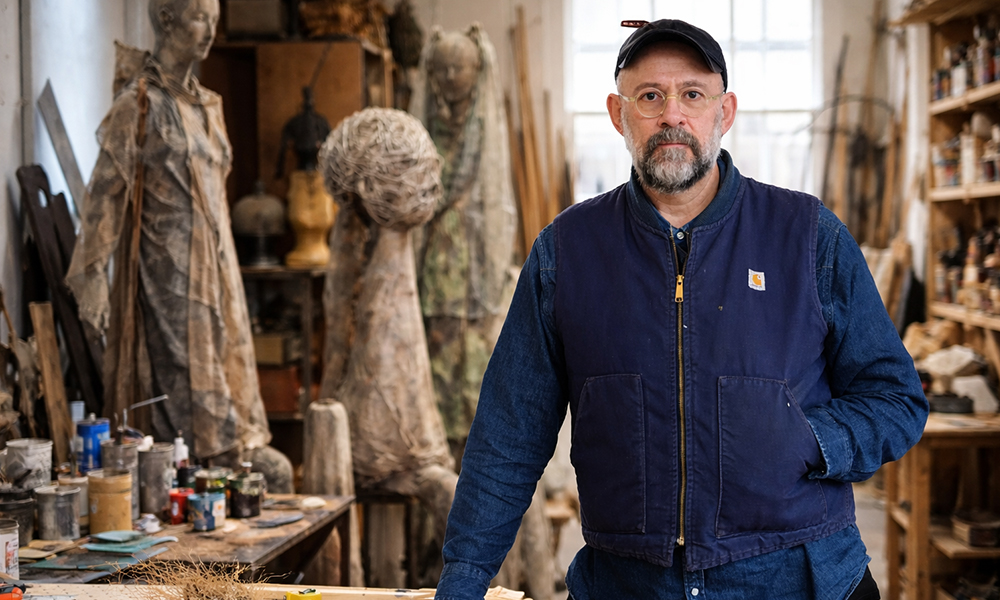

Enrico David’s artistic practices center around conceptual examinations of memory and absence of memory as well as transformation, all of which are connected through an emotional thread for the artist. When one considers his work, it often gives off a feeling that is both personal and very disturbing in that one doesn’t know exactly.
For Enrico David, the representation of an object, such as a person, experience, and even an emotional connection, is very different from simply making a sculpture of an object or form. His sculptures represent an idea of absence through the presence of the missing experience. They allow the viewer to experience an absence, as opposed to experiencing what is physically present.
David creates in a range of different media: sculpture, drawing, textile and installation; this enables him to explore the body and the relationship between Memory and the Body in many ways. Many of David’s works are broken, distorted and/or incomplete. His work reflects the idea that one’s identity is not fixed, but rather, that it’s constantly evolving.
David does not tell his audience what he intended to communicate with his work, but rather leaves it up to the audience to interpret what he intended. David’s work evokes Personal Memory, yet still allows for many interpretations.
Objects as Memory, Absence, and Transformation
The body is recurrently used within David’s work as a vessel of remembrance. Figures created by David resemble human beings through sculptural shapes, but they do not replicate real human bodies. For example, limbs are sometimes tapered, surfaces are often unrefined, and facial characteristics aren’t clearly defined.
Textiles are an integral part of David’s creative process. Use of textile materials including fabric, sewing, and the use of soft materials create an idea of intimacy and vulnerability associated with the body; they depict clothing, skin, and the protection of the body. Fragility and impermanence are also suggested with the use of textiles.
The idea of the “avatar” is central to understanding his approach. In this context, an avatar is not digital, but symbolic. Objects act as vessels for memory, representing something that once existed but cannot return. They hold emotional residue rather than factual history.
His work also resists spectacle. Instead of dramatic statements, David offers slow encounters. Viewers are invited to spend time, observe closely, and reflect. The experience is less about explanation and more about feeling.
Ultimately, Enrico David: ‘It’s as if the Objects Are There as an Avatar for Something That Has Gone’ reveals an artistic practice built on emotional depth. David uses objects to represent emptiness, to show us that even when something is gone it continues to influence our perspective, to guide our response, to create our memory.