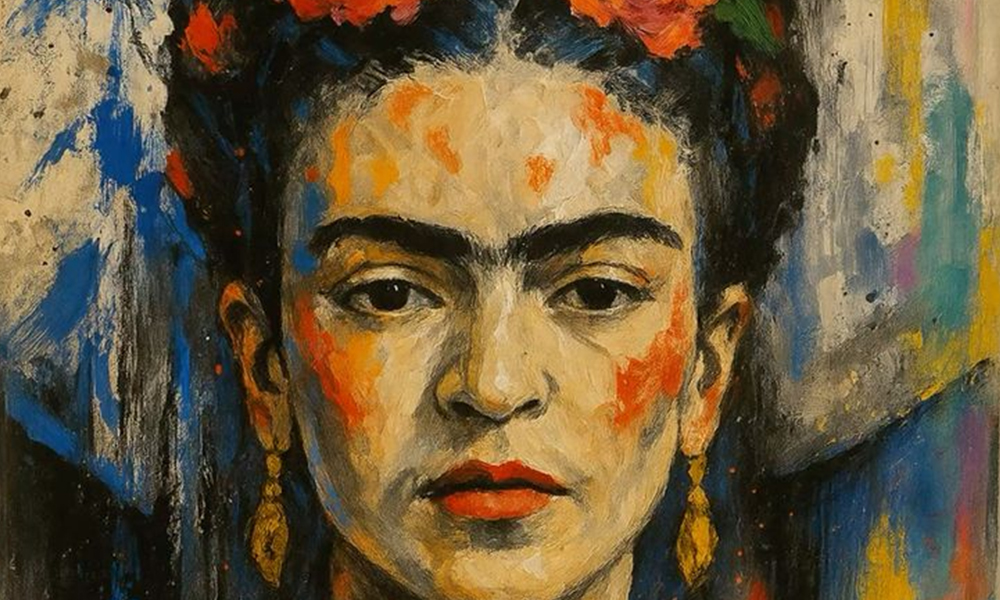

The curators of the forthcoming blockbuster Frida Kahlo show at Tate Modern have revealed more details about the exhibition, highlighting the late Mexican artist’s “impact on women artists across Mexico, the Americas and Europe from 1970 to today”. Frida: the Making of an Icon (25 June-3 January 2027) also includes highly personal works reflecting her suffering post-miscarriage, along with pieces that explore her “complex relationship with the United States”, the co-curator Tobias Ostrander said at a press briefing.
The exhibition, sponsored by Bank of America, includes more than 30 works by Kahlo exhibited alongside photographs and personal artefacts. It includes a depiction of the nurse Eva Frederick who had taken care of Kahlo after a miscarriage in Detroit, whereas the painting My Dress Hangs There(1933-38) conveys her conflicted feelings about America, as explained in a Tate statement:
The event is being hosted by the Bank of America and will showcase over 30 paintings by Kahlo, accompanied by photographs and personal belongings that reveal the private life of the painter. Some of the works showcased in the event include a picture of Eva Frederick, who was the nurse attending to Kahlo when she suffered a miscarriage in Detroit. My Dress Hangs There (1933-1938) is also a major piece that depicts Kahlo’s feelings towards American industries and the culture.
One-third of the exhibit will be dedicated to Kahlo’s involvement with Surrealism. This connection developed following her 1939 exhibition in Paris, where she was invited by André Breton and other Surrealist artists to present her work in the group exhibition Mexico. For the exhibition at the Palau Baro Dalmassy, a series of eighteen small-format paintings were also displayed: “These helped to introduce Kahlo to a European public. One of these paintings, The Frame of 1938, is included in the Tate Modern exhibition in a consideration of “the emerging international reputation of Kahlo.
Considering the position of Kahlo’s work today compared to the past, Catherine Wood, the Programme Director of Tate Modern, commented that when her work had an exhibition there in 2005, she and a few other female artists represented the relatively short list of female artists being given serious institutional attention. Today, the impact of Kahlo’s work is hard to deny; it continues to alter the art world and affect artists.
The series will also situate the work of Kahlo in the larger tradition of modern and contemporary artists who have explicitly referenced Kahlo’s imagery and persona in their work. Pieces such as Self-Portrait with Thorn Necklace and Hummingbird (1940), which will make its first appearance in the UK, will share a platform with portraits of artists such as Tracey Emin and Yasumasa Morimura, who have referenced Kahlo in their work.
The last part is dedicated to “Fridamania,” where Frida Kahlo’s phenomenon has led to a global icon in pop culture. From toys to fashion and sanitary items, Frida Kahlo has been used in a multitude of ways in many aspects beyond art. This art display will move from the Museum of Fine Arts in Boston to London to showcase Frida Kahlo and how this icon has managed to become one of the foremost artists in the modern period through this art display.