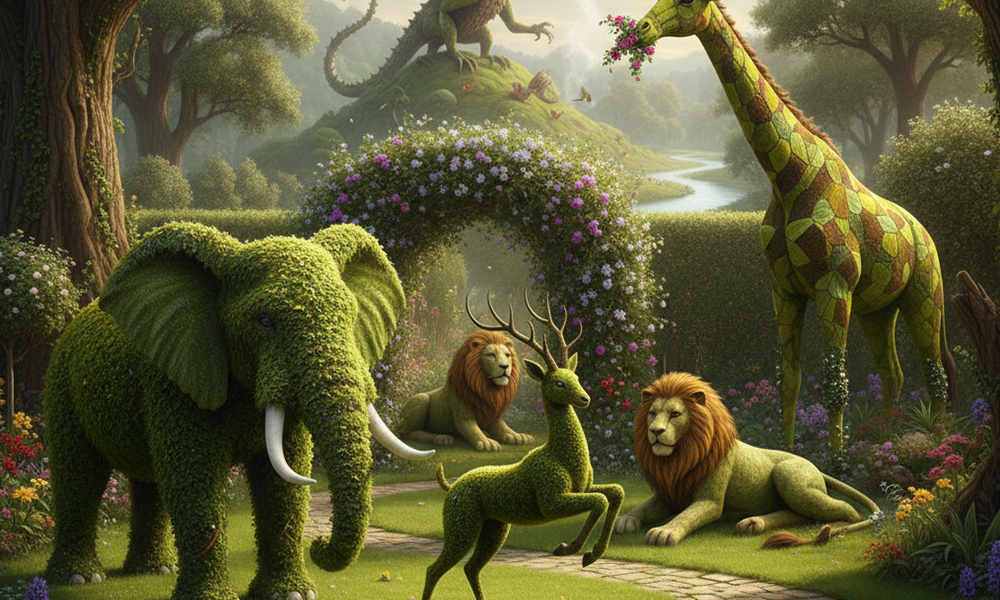

When plants are shaped like animals, there is a gentle conversation between nature and imagination through the use of art. Through this artistic technique, the use of plants such as leaves, petals, stems, seeds, and dried plants to create designs that take the aspect of animals is explored. The process is all about suggestion, whereby nature helps guide the creation of the design.
The essence of this art is “transformation.” Plants, which used to grow in abundance in soil and sunlight, find new vitality in this form of art. “The curved leaf becomes the wing of a bird, groupings of leaves may represent fur, while thin stalks can be transformed into the legs of an insect.” These works of art do not require too much control or observation. They invite people to notice common animals from an unconventional and natural source.
The creation behind such pieces is slow and deeply intentional. To work with the botanical elements of nature requires patience and a respect for their form as it naturally comes. You cannot force-feed plants, like you would clay or metal, into shape. They bend, break, and age in their own way. This quiet collaboration, between human hands and elements of nature, gives the work its honesty and depth in emotion.
What really makes these floral animal outlines compelling, however, is their subtle emotional presence. The animals often seem quiet and still, introspective. They neither perform nor demand. They merely exist softly, almost in dream or memory. That allows for a sort of intimacy between artwork and audience.
There is a feeling of fragility in these works. By nature, plants are fragile and temporal; changing them into animal forms makes the reality of the shared vulnerability of all living things even more emphasized. Colors will fade with time, and textures change. Instead of characterizing this process as one of decay, it actually becomes part of the meaning of the artwork in its own right.
Through the combination of plants and animals, this installation breaks down the norms. Plants and animals have traditionally been considered different things altogether. In this installation, the connection between the two is portrayed as being more than what the eye can behold. Both plants and animals live in the same spaces. Although plants are actually similar to animals, the emphasis is clear – everything is linked.
The simplicity in the visual design of the various compositions is also significant. In most cases, the background is minimal or absent, ensuring the botanical form of the animal takes center stage. This is especially significant in ensuring that there are no distractions in the composition. It also enables the imagination to run wild in relation to the emotional aspect.
More than beauty, these works encourage environmental contemplation. Plants forming animals subtly bring into view how much wildlife depends on healthy natural systems. Without dramatized images or direct messages, the artwork brings soft awareness of conservation and sustainability in coexistence. It questions the viewers to give a thought to how human actions affect the natural world.
However, within this artistic expression, there is also a counterpoint of controlling and yielding. Thus, as a human artist arranges and composes, it is nature that determines and creates the final single outcome. This is not different from the overall human relationship with nature. This is a relationship that needs to be controlled.
Where Plants Take the Shape of Animals is a reflection on transformation, about patience, about connection. It’s a show about how art can exist alongside, rather than overwhelm, nature. Through thoughtful design, plants become animals, while the more-than-humble materials are poor conduits for the secrets of the animate world.
This piece serves as a reminder that beauty does not have to make statements in bold fashion. Sometimes it is present in softness, in simplicity, in the detail of seeing. The installation invites us to re-evaluate our viewing relationship with nature, as observers, yes, but also as participants in this fragile system we share with nature.