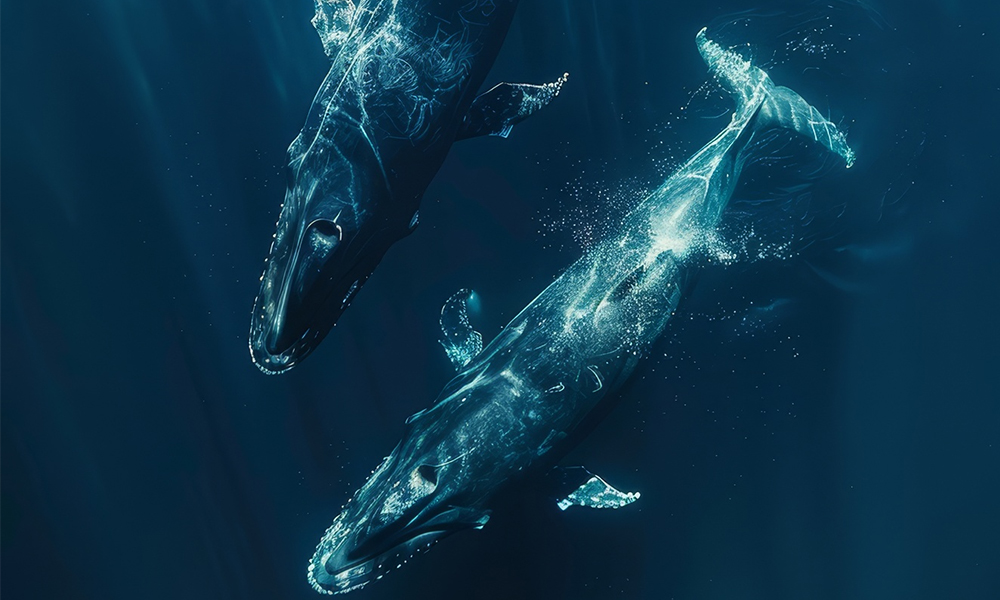

In the boundless and constantly shifting ocean, silence and stillness are anomalies. However, in the silent depths, the mother humpback whale and her baby float together in an interaction characterized not by the dynamics of motion but by the power of connection. A Mother and Calf at Rest: The Quiet Intimacy of Humpback Whales captures the silent moment among the swiftness of the ocean—a moment characterized by the beauty of motherhood in the silent depths of the ocean.
Humpback whales can perhaps be the most expressive, expressive creatures that can be spotted within the oceanic setting. Highly known for their beautiful songs as well as their acrobatic stunts when they jump out of the water, these creatures are actually known for their association with power. However, as these creatures lie together as a mother and her calf, this strength morphs into something that is characteristically human – that of nurturing and calmness. The mother systematically places her enormous body close to that of her calf as if imparting shelter in the midst of the vast ocean, where vulnerability lurks around every corner.
A calf also requires sleep. A calf has to come out of the water for air. Calves also need to be close to their mother. Calves do not sleep like human beings do. A whale does not sleep. A whale sleeps in a state called half sleep. In half sleep, a whale keeps half its brain awake. When this happens, the mother also slows down. The calf also does the same.
This is a relationship which is handled with delicacy, with nothing much happening but a series of subtle actions. A gentle push, a shift in position, or breathing in sync with one another reaches a sort of communication. These moments in photographs look almost transcendent: two giant creatures paused in a blue landscape, linked by instinct and trust. The non-urgency is what gives this image its emotional substance, a reminder that even in the most untamed spots in the world, tenderness can exist.
This is a bond between a humpback and her offspring that is constituted with great sacrifice. The moths travel long distances of thousands of miles to reach the warmer breeding grounds, and this is also where offspring are born. This is the stage where the female moths eat little or nothing at all, and this includes depending on the nutrients stored for the nourishment available in her milk, which would be sufficient to feed her rapidly growing young ones. It is during this stage where, through resting, her strength is being conserved and her young ones are not far from her.
Just such a photographing moment will invariably be recorded with great patience and respect. Just such pictures will be taken from a respectful distance in order not to disturb the whales. There will be a feel of intimacy but not intrusion. Thus, a private bond can be recorded without it being broken.
Owing to its beauty and aesthetic appeal, these images carry an essential message together with that aspect. The humpback whale, on the verge of extinction due to commercial whaling, illustrates the message related to power and survival. The illustration of “A mother and her calf resting” carries an essential message that goes further than that in the nuclear family, which is survival itself. The little whale means the next generation that requires a sound ocean and the survival of all these creatures.
“In the end, therefore, *A Mother and Calf at Rest: The Quiet Intimacy of Humpback Whales* urges us to pause, to observe,” In a world that is attuned to the vibrations of sound and the tempo of time, this photograph urges us to remember that “in the quietness, we often discover what is important to us.” Whether in the relationship between human parents and children or between whales and their offspring, this is motherhood that speaks through a universal voice that whispers through the water.